
Paint by Numbers: The New Corporate Yardstick
Paint By Numbers: A New Monthly Feature
In this new series I’ll be highlighting one or more charts that provide visual clues into economic and market trends outside the regular financial media numbers. My hope is that each chart opens a window onto something readers haven’t considered or don’t fully understand.
I’m an avid collector of charts, so please feel free to email me at Matt@TableauxWealth.com any charts that strike you as worth a second look.
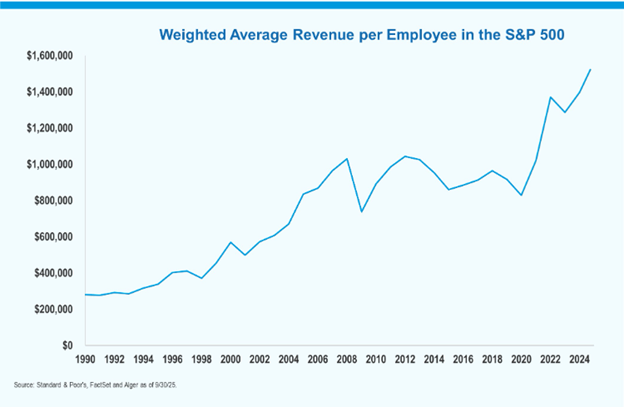
The annual weighted average revenue per employee (RPE) for companies in the S&P 500 Index
How Should We Measure a Company’s Productivity?
Following up on my last article, on AI’s current and potential economic impact, I want to highlight a change in how I believe companies will measure productivity and progress.
Historically, companies have focused on the top line and the bottom line—that is, revenue and earnings, respectively. These metrics are easy enough to understand, but they obscure how efficient the company is, both in its operations and in reinvesting any profits.
For that reason, analysts often look to other metrics such as profit margin over time and return on invested capital (ROIC), which is the percentage return on profits from the funds invested in the company by stock and bond holders. Companies in certain industries, such as grocery stores, are very expensive to operate and therefore have traditionally low operating profit margins of 1–3 percent and typically low ROIC of 3–4 percent, compared companies that are cheaper to operate, such as technology companies.
Are You Productive (with AI)?
With AI now penetrating just about every industry, I suspect that a key focus of analysts going forward will be the average Revenue Per Employee (RPE). If executive teams and investors really want to understand whether AI and other company investments are affecting productivity, they’ll want to know if each employee can do more, or if the company can do more with fewer employees.
RPE can be used to measure a company against itself over time or against its competitors. It may also be useful for comparing the rate of change of revenue per employee from industry to industry.
If AI is as revolutionary as claimed, I bet you’ll soon be seeing every company touting RPE as a new corporate yardstick.