
What I Told My 30-Year-Old Brother About Investing
The other day I was reviewing my personal portfolio and how it has been growing for the last five years. The money that had gone in when I was 18 (I’m now 23) had grown considerably.
That same week my 30-year-old brother asked for help investing and when they should start. My answer was immediate—yesterday.
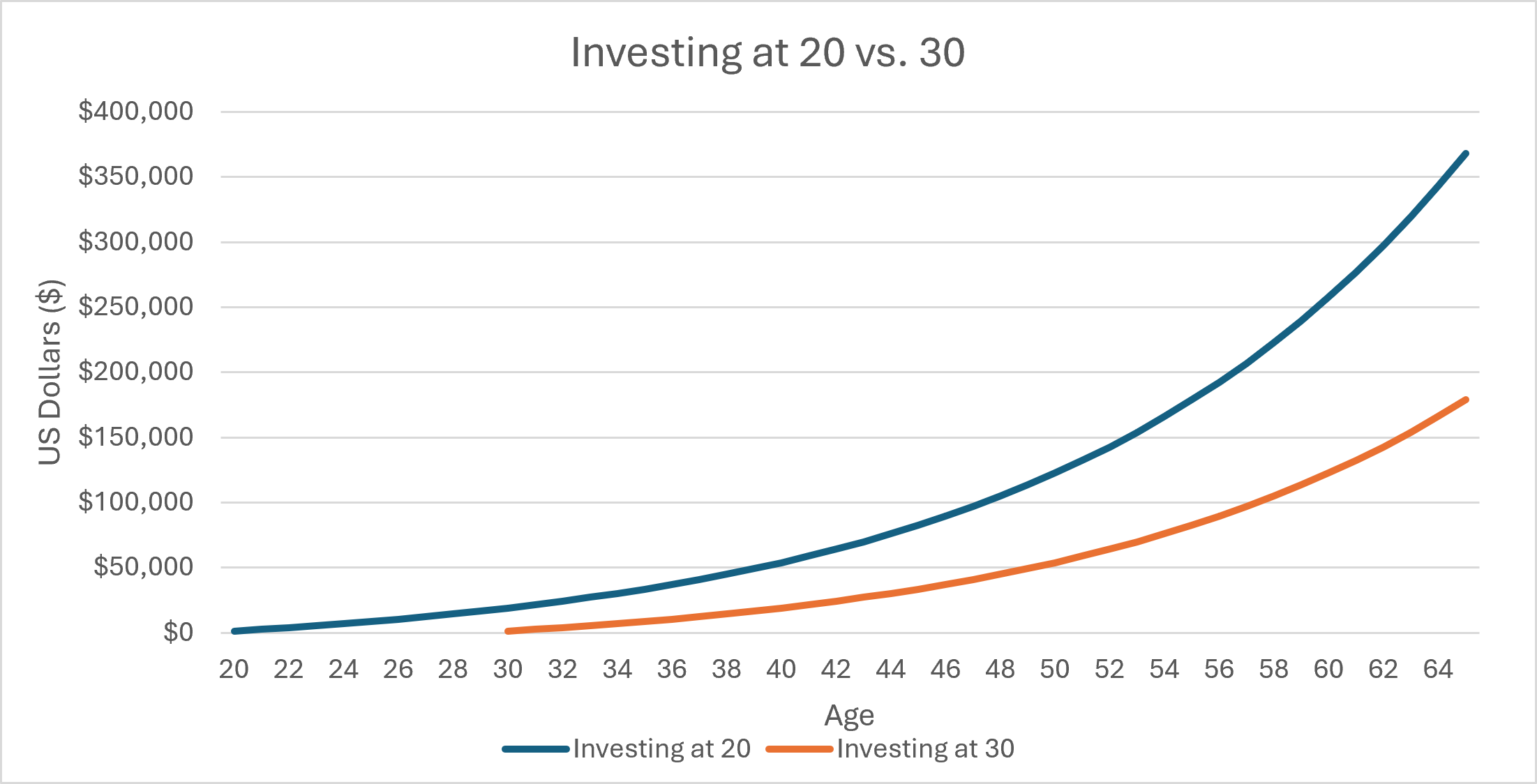
That conversation got me thinking. What does a ten-year head start look like in dollars? So, I ran the numbers. If he starts investing $100 a month at the age of 30 and sees a 7 percent annual return (a broad assumption for illustration purposes only), he’d have roughly $180k by the time he is 65.
Now let’s compare starting ten years earlier, keeping all other assumptions the same. By starting ten years earlier, my account could potentially grow to about $360k. So he invests for 35 years and I invest for 45 years and my account is double his...that is the remarkable reality of compound growth.
Past performance does not guarantee future results. This example is for illustration only and does not represent any specific investment. Consult a financial advisor before making investment decisions.
The graph above shows us how time is our greatest friend when it comes to investing. Think of it like a snowball rolling downhill. When it starts, it is small and only adds a little at a time. But as it grows, the snowball gets exponentially larger and heavier.
That’s the magic of compound interest, what Albert Einstein called the eighth wonder of the world. It’s almost incompressible to the human brain. As linear thinkers, we’re not accustomed to thinking about exponential growth.
The more time, the greater the effect. Returns aren’t the same every year in real life, but over long periods of time the stock market has rewarded patient investors. If you are young, or have young adults in your life, do everything you can to convey this message.
When you're first starting out, it's going to feel slow. Look at the chart. In the first 10 years, the account only grows to less than $20k. It doesn't sound like that much of a head start. But even small amounts that you can scrape together early in life can have a huge impact down the road.
The difficult reality is that our wants and needs of today take precedent over the unknown of the future. It's really hard for anyone to picture themselves at 65 years old, much less someone who is only 20 or 30.

Image created with ChatGPT
Of course investing feels risky, especially when you’re young and every dollar matters. The irony is that avoiding the market out of fear is one of the most expensive decisions you can make. Those who delay investing will need to contribute significantly more money later in life just to catch up and have less time to recover from downturns.
If you’re 18 or older and you have a job, consider beginning by opening a Roth IRA (the Roth IRA is generally preferable at a young age because you're in a lower tax bracket). If you have children under the age of 18, consider opening a custodial account, 529 plan, or Trump account. Your future self and adult children will thank you.