
What Do You Want from Retirement? Start With Your Values, Not Your Portfolio
I have a client, we’ll call her Carrie. When Carrie first came to me to build her retirement plan, I didn't start with her tax return. I started by asking questions like "What do you want to do in retirement?" and "How do you want to spend your money?"
Those aren't financial planning questions in the purest sense. Most people assume that handing an advisor a tax return and a few account statements is enough to build a comprehensive plan. But money is only a tool — a means to an end, not the end itself. Money alone doesn't create life satisfaction, but it can help buy freedom, and retirement may be the ultimate expression of freedom.
Carrie’s answers came easily. She's deeply involved in her church, and she wears her values on her sleeve. Her financial plan reflects that: a charitable giving budget, an annual church trip to Europe, and funds set aside to help her kids and grandkids when they need it. Because her values were so clear, it was simple to build a plan that used money as a tool to support the life she wanted.
Most prospective clients don’t arrive with that kind of clarity. Before diving into the traditional retirement topics such as Social Security, taxes, and investments, it's worth starting somewhere more foundational: your values.
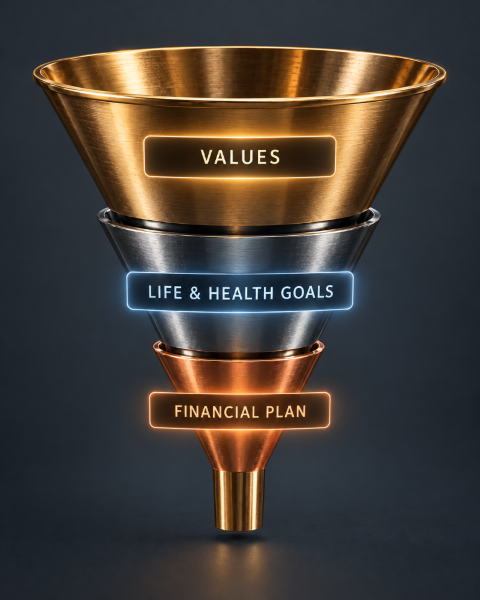
Image created with ChatGPT
Think of retirement planning as a funnel. Start at the top with your values. What genuinely drives you and brings you fulfillment? From there, narrow down to specific life and health goals. Only after that should you build the financial plan underneath it all. Most of us do this backward, starting with the numbers and hoping the meaning sorts itself out later.
Financial professionals have a habit of reducing big life decisions to a simple cost-benefit ratio. College is a good example: it's expensive, but a planner will tell you it's "worth it" because your lifetime earnings go up. That's true, but it misses most of the picture. College can also shape the career you end up loving for four decades, and the friendships that outlast the degree. None of that shows up on a balance sheet.
Retirement deserves the same wider lens. Before you retire, it's worth asking questions money can't fully answer. Are you missing time with family to punch the clock a while longer, or would you actually miss the community you've built at work? Could retiring too soon dull your sense of purpose, or could staying too long cost you your best physical years to enjoy it? Similar questions apply to experiences, creativity, community, and personal growth. It's about creating the life you want your money to support.
George Kinder, widely considered the father of "life planning," built a simple exercise around three questions that can offer some insights. First, if you had all the money you needed, now and in the future, how would you live? What would you change? Second, imagine your doctor tells you that you have only five to ten years left, though you'll feel healthy the entire time with no warning of the end. What would you do differently? Third, imagine you're told you have just 24 hours left. What did you miss? Who did you not get to be?
Sit with those questions, alone or with a spouse, before you sit down to build a plan. They tend to surface what actually matters faster than any risk-tolerance questionnaire ever will.
Once you know your values, it helps to know how to spend in a way that supports them. Researchers Elizabeth Dunn and Michael Norton, authors of the book Happy Money, found that how we spend often matters more than how much we have. Their research consistently shows that spending on experiences — travel, meals out, a concert — creates more lasting happiness than spending on things, even when the amount is small. They also found that "buying time," by outsourcing chores you dislike to free up hours for what you love, reliably improves well-being. And spending on others, whether through gifts or charitable giving, produces a warm glow that tends to boost our own happiness as much as the recipient's.
None of this replaces the numbers. Social Security timing, tax planning, and portfolio construction all still matter. But money only works as a tool if you know what you're building with it. Before you turn the page to the next chapter, take the time to think and learn about what fulfills you.
This article first appeared in The Berkshire Business Journal.