
In the wake of the Trump Administration’s October announcement that it “automatically enrolled” 60 million children in Trump Accounts, we thought it good time to revisit our discussion of 530 A accounts – aka Trump Accounts. What has – and hasn’t – happened with these new-fangled children’s savings accounts since their creation five months ago?
The basic framework of Trump Accounts, you may recall, is that friends and family, employers, and nonprofits (all subject to various contribution limits) and government entities, including the federal government, (not subject to contribution limits) can contribute to children’s Trump accounts, which are invested in low-cost index funds until the child turns 18. Upon reaching 18, the accounts are converted into regular individual retirement accounts, subject to the distribution rules generally applicable to IRAs. Perhaps most notably, upon announcing the legislative establishment of these accounts, the Trump administration pledged $1,000 in seed funding to all American citizens born between 2025 through 2028. [For a more robust primer on the basics and pros and cons of Trump Accounts, see our July Insights piece.]
The first five months
Beginning July 5, 2026, parents and guardians could open Trump accounts for their children and contribute up to $5,000 per child annually (with a maximum of $2,500 coming from employers). But by mid-September, fewer than 8 million such accounts had been opened. A Commonwealth study found that only 5% of eligible low to moderate income families had opened a Trump Account. Presumably in response to these numbers, on October 1, the Trump administration decided to automatically enroll eligible children. This brought the number of accounts up to roughly 70 million.
If you are a parent, therefore, your first question should no longer be whether you should open a Trump Account for your child, as Treasury may have already done that for you. The better question is whether anyone has claimed the account and unlocked its benefits.
The mere existence of an account in your child’s name, even if he or she was born in 2025 or 2026, is not sufficient to receive the government’s pledged $1,000. To benefit from the federal seed funding, parents must claim their children’s accounts through the official Trump Accounts mobile app or web portal. If you are a parent, you should take a few minutes to officially claim your child(ren)’s account by logging in, verifying identity information, reviewing your child(ren)’s information and accepting the account terms. This will allow you to contribute funds now or in the future, and if your children are eligible for contributions from other sources, it will allow them to realize those benefits.
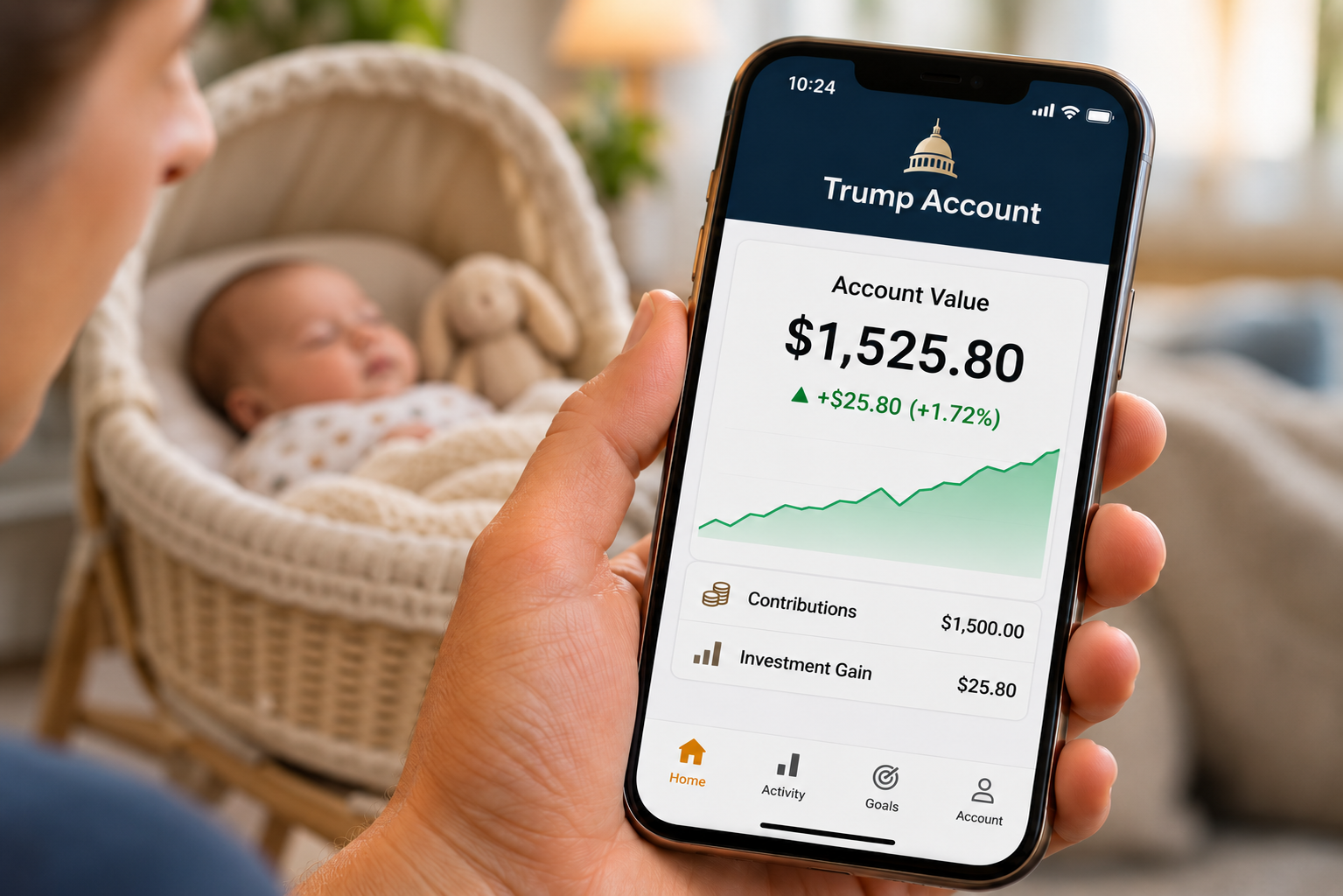
Image created with ChatGPT
Nearly 70 million Trump accounts now exist, but active parental engagement still appears limited. Treasury reported that only roughly 164,000 of the newly auto-enrolled accounts had been claimed during the first week after enrollment.
However, while parental involvement may still be limited, philanthropic interest appears to be gaining traction. The White House reported that as of early October, $4.5 billion had been deposited in Trump Accounts. According to the government press release, the deposits comprised $600 million in direct contributions from family and friends, $1.3 billion in $1,000 government seed contributions, and $2.6 billion in philanthropic gifts.
As for employer contributions, there are 70 plus large companies concentrated largely in the finance and tech sectors that have announced programs to contribute to employee children’s Trump Accounts. This number is, of course, a small percentage of U.S. employers but may, or may not, continue to grow.
Philanthropic “qualified general contributions”
It bears noting that in addition to the federal seed funding, there have been a few philanthropists who have pledged “qualified general contributions” that fall outside the $5,000 annual contribution limits. For example, Michael and Susan Dell committed $6.25 billion to provide $250 contributions to children born between 2016 and 2024 who live in ZIP codes with a median income below $150,000. Other philanthropists have created similar state-wide programs, such as hedge fund founder Ray Dalio in Connecticut and
Brad Gerstner, CEO of Altimeter Capital, in Indiana. Whether these philanthropic initiatives will materially increase adoption of Trump Accounts remains to be seen.
Stock contribution rule change
Along with the October auto-enrollment, there was another notable administrative change published in temporary Treasury Regulations. Treasury will now allow, in addition to cash contributions, donations of certain publicly traded securities into Trump Accounts. The accounts themselves must still be invested in diversified, low-cost index funds, but the gifting rule change has the potential to boost private contributions from large donors. Such donors can now avoid the capital gains taxes that would otherwise be incurred if they had to liquidate appreciated stocks before making cash gifts.
Family contribution analysis unchanged
The recent enrollment changes have dramatically increased access to Trump Accounts. What hasn’t changed is the underlying analysis for whether a Trump Account is an appropriate savings vehicle for a particular family. For families already inclined to contribute, the case remains largely the same as it was at launch: a potentially attractive long-term savings vehicle but one that should be evaluated with your financial advisor alongside more established options such as 529 plans, custodial accounts, and Roth IRAs for working children.