
Still Don’t Understand Cryptocurrency? Start Here.
Part One: What Is Money?
A lot of people I talk to don’t really understand what cryptocurrency is. I don’t blame them. Most explanations of cryptocurrency, even the best ones, quickly dive into jargon and technicalities: the blockchain, mining, hash codes.
These nerdy details turn many people off. And I don’t think you really need to know them to understand cryptocurrency, aka crypto.
Instead, I’d like you to think about crypto as a shift toward a new kind of money. “Toward” because it’s not quite there yet. To understand what I mean, we should first get straight on what money is.
What Is Money, Really?
Like gravity, money is one of those things we have an innate feel for, but when asked to explain, we find it’s not so easy. Let’s give it a shot.
(As a stand-in for money, I’ll use the U.S. dollar, and as a stand-in for cryptocurrency I’ll use Bitcoin, today’s largest and most valuable cryptocurrency by market capitalization.)
1. Money Is Used to Buy and Sell Things
The first thing to say about money is that we use it to buy stuff. We also accept money from others when we sell stuff. In this role, money is called “a medium of exchange” by economists, and it’s perhaps the most important thing money does for us.
Using money as a stand-in for value makes trading with other people much easier and more secure than bartering or making promises or whatever ancient practice we might have had before money. When you think of it that way, money is a kind of early and very clever technology.
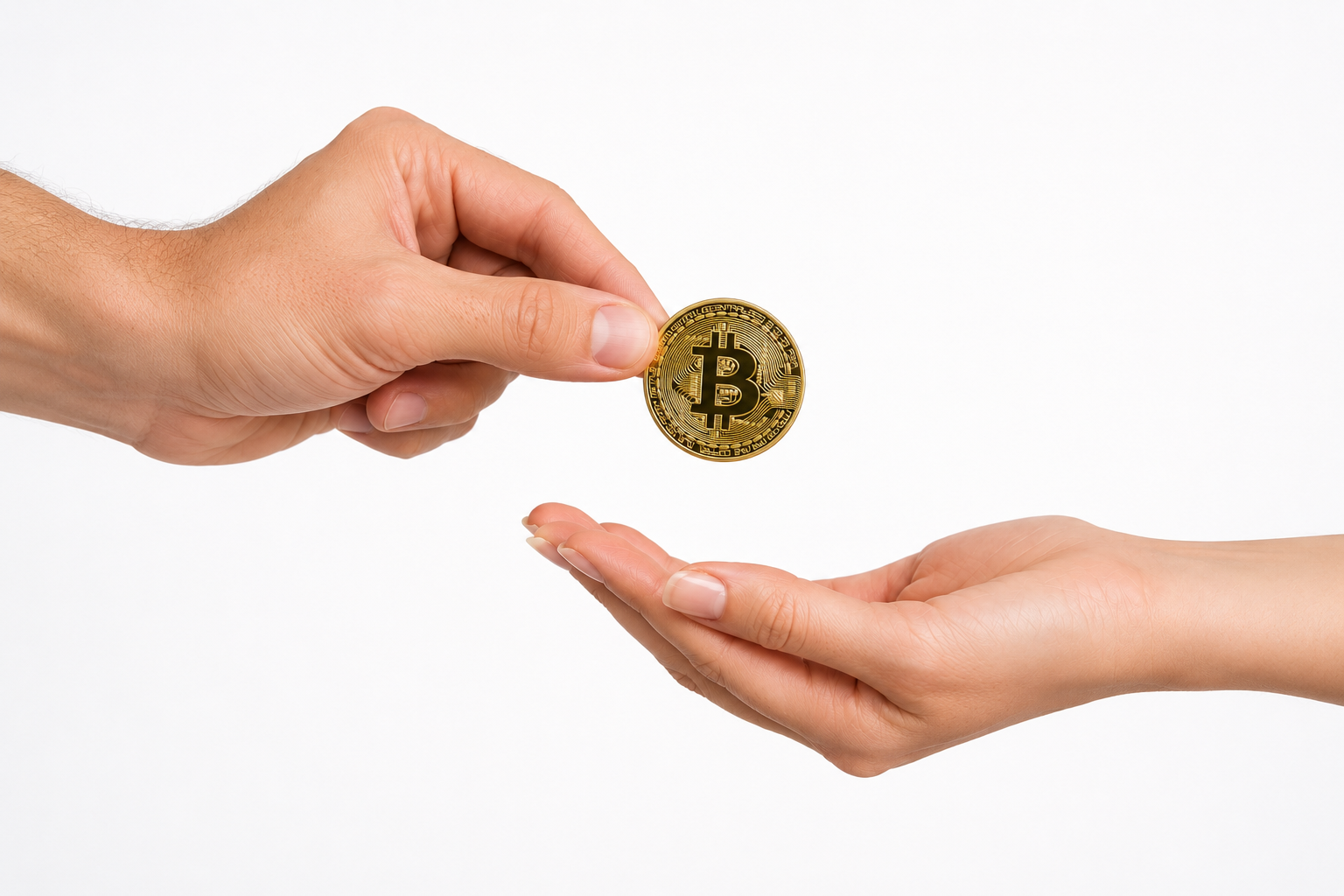
For a hamburger today?
Image created with ChatGPT.
2. Money Is Used to Communicate Value
Another thing we can say about money is that it helps us talk about value. In the U.S. and in much of global finance we use U.S. dollars to communicate value. In this role, money is called “a unit of account” by economists.
Money allows us to think and speak very precisely and articulately about value. As long as the value of a dollar is understood, we can mention a price to anyone on the globe and they’ll know in a very efficient way what the value is that we’re trying to communicate. Money is a very useful shorthand for thinking and communicating.
3. Money Is Worth Something
As a medium of exchange, whatever money you happen to have on-hand—in your wallet or purse, in your bank account, or in “cash equivalents” such as CDs or money market shares in your brokerage account—that money has a value. You can use it now or in the future to buy more stuff or invest.
In this role, money is called a “store of value” by economists. It’s why cash is considered an asset. Cash is not only the most liquid asset class; it’s the very definition of liquidity. In U.S. dollars, cash has a fairly dependable value, at least over the short and medium term. Over the long term, its value can change. The U.S. dollar today doesn’t buy what it did in 1980, much less 1908.
Who Decides Whether It’s Money?
Do you ever find yourself in line at the grocery store checkout wondering if the dollars in your pocket will be accepted?
Of course not. But why not? Why do we trust the U.S. dollar?
The not-very-helpful answer is because everyone else trusts it. As economics writer Peter Coy has said, “The only requirement [of money] is that [it] has to function as a medium of exchange, and that role is socially determined. I will accept just about anything from you as payment if I trust that the next person in the chain will accept it from me.”
A slightly better answer is that we trust dollars because we trust the system of institutions behind the dollar. Money is created, controlled, and circulated by a combination of the U.S. Treasury (part of the U.S. government), the Federal Reserve (the U.S. central bank), and commercial banks (large and highly regulated financial institutions). The details are different in other countries, but in most capitalist, free-market economies, money works along the same lines.
This system of governments, central banks, and commercial banks referees everything from keeping the ongoing record of whose money is whose and verifying transactions all the way to how much money is in circulation, including whether to print more of it.
It’s a pretty strong system of institutions, at least here in the U.S. Our institutions aren’t perfect, but they’ve been good enough to make the dollar the world’s most trusted currency.
This wasn’t the case in colonial America (see Ken Burns’s latest documentary) and is still a problem in countries ranging from Argentina to Lebanon to Sierra Leone. In those colonies and countries, your cash on one day might be worthless the following month. The values of these currencies are far from stable.
The U.S. dollar and the financial system behind it have enjoyed widespread trust for a very long time. They’ve also endured periods of lower trust and moments of outright crisis. The Great Depression; the financial crisis of 2008; the inflation of the ‘70s, early ‘80s, and more recently.
As trust in institutions has eroded in the last few decades, so naturally has trust in the dollar, which is grounded in institutions. The great financial crisis was a watershed in that decline in trust. The immediate response to the crisis was the launch of the world’s first cryptocurrency, Bitcoin—an attempt to change who keeps the record, and whom you need to trust.
This is part one of a three-part series. Here are parts two and three .