
Paint by Numbers: AI Optimism for the Rest of Us
As financial advisors and planners, a key part of our job is helping clients think through the uncertainty of the future. We help put that uncertainty in context and measure its impact so that we can make good financial decisions today despite not knowing what will happen tomorrow.
In some cases, there are risks that we can mitigate with financial products, such as buying life insurance. In other cases, risks cannot easily be offloaded, but can be understood--say, inflation that exceeds historical averages.
Right now, when we talk to clients, we palpably feel a risk that is much more difficult to model in a financial plan: how will artificial intelligence change our lives? That said, while the changes feel inexorable and unmanageable, we believe that doing our best to understand the potential positives and negatives will put each client in the best position to adapt.
Much has been said about how AI may wreak havoc on our economy and humanity. For example, a few weeks ago, a hypothetical scenario issued by research firm Citrini Research went viral for its examination of how AI might have a larger and earlier economic impact than expected. It analyzed the economic linkages between various sectors that could be affected by AI job displacement.[1]
On the other side, the unbridled AI optimism we see in the headlines generally flows from Silicon Valley venture capital firms who are underwriting investments in AI-related companies (see Marc Andreessen’s Techno-Optimist Manifesto) or from companies that are tech-savvy enough to begin using AI not only to chat but also to act for people in their daily lives with tools like OpenClaw (see CNET on Everything You Need to Know About This Viral Open-Source Agent).
We believe a more measured view is appropriate. At heart, AI is a new tool, and an incredibly powerful one, if we consider how we can use the technology without letting the technology use us. Having just spent two days at a financial industry conference filled with tech vendors trying to sell “AI-native” products, I can tell you that there are definitely many companies that offer solutions looking for a problem. Do I really need an AI recording tool that measures when clients sound concerned or fearful or grades my own job in providing open-ended questions and follow-ups? Probably not.
But there were some tools that seemed incredibly interesting. For example, systems that can neatly gather and tie together all the information related to a client--basic facts, meeting notes and transcripts, financial plans, and estate planning--so that we can more efficiently provide personalized and detailed recommendations and strategies.
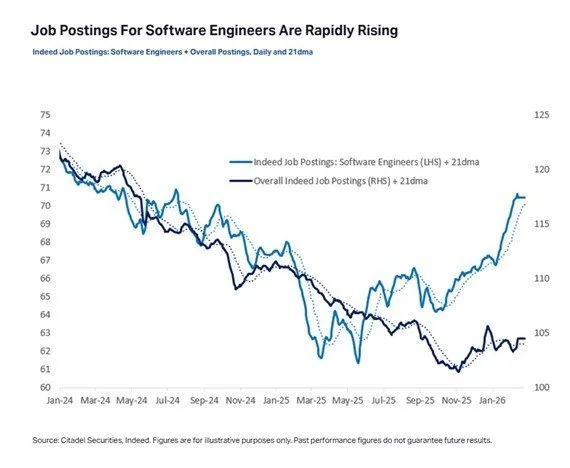
What is clear, though, is that rather than reducing the need for software, AI is actually allowing companies to create software faster and adapt more quickly to the needs of its customers. In fact, the recent chart below from Citadel Securities demonstrates that despite the hype about coders going the way of the dodo, companies are actively seeking to hire software engineers.
Moreover, by using AI as an always-accessible teacher and employee, individuals can learn and build technology for themselves without knowing how to code. Or they can experiment with a business idea before committing to investing capital in the business. As one example, a friend of mine has been using various LLMs to refine his fundraising pitch for a startup. The AI can predict the tough questions investors might ask, so my friend has been able to quickly become better at convincingly explaining concepts that he otherwise would have had to learn through trial and error over an extended period of time.
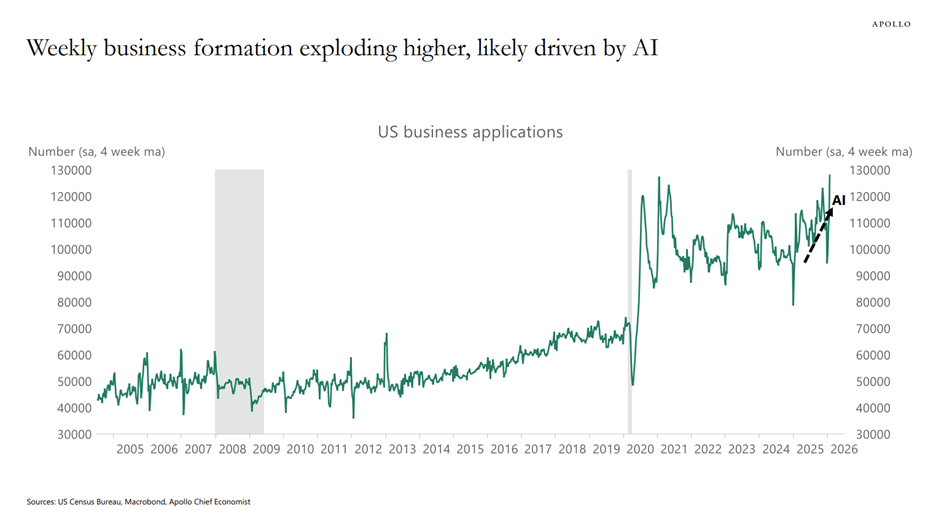
Moreover, in six months, with just two co-founders and overseas software engineers, he has built a product that has gained traction with users without any marketing expenditures. This kind of convenient and intelligent learning may actually be leading to more entrepreneurship and more businesses being founded. As the chart below shows, the United States has seen a recent uptick in new business formation.
If nothing else, I urge you all to give AI tools a try and be creative and curious about how they can help you. For those who want to read more on the topic, I recommend writings by Ethan Mollick, a University of Pennsylvania professor whose research focuses on how we can use AI in our daily lives, especially in education. His blog, One Useful Thing, is a kind of serial guide to using AI. He also wrote the very accessible New York Times Best Seller, Co-Intelligence: Living and Working with AI.
[1] The 2028 Global Intelligence Crisis: A Thought Experiment in Financial History, from the Future, https://www.citriniresearch.com/p/2028gic