
Avoid This Headache for Your Executor
Nowadays, most securities of publicly traded companies are owned in street name by brokerage firms. Put plainly, when you buy stocks or bonds through a brokerage firm—Schwab or Fidelity, for example—your securities are held by the brokerage firm for the benefit of you. On the books of the company or other issuer of the stock or bond, the brokerage firm is the listed owner. That brokerage firm is responsible for keeping track of the individual account holders who are the beneficial owners of the securities. The brokerage firm is also responsible for passing along dividends and communications on mergers, acquisitions, and shareholder votes. By owning securities in street name, you (the account holder) or your advisor can easily sell or transfer your stocks or bonds with a few clicks of a mouse in your brokerage account at minimal cost. For decades, owning in street name has been the norm. But it’s not the only way securities are owned.
Some securities, albeit a dwindling number, are still held the old-fashioned way: as physical certificates. In this case, the security is registered in your name on the issuing company’s books, and you receive a paper certificate representing and proving your ownership. You must safeguard your certificate until you sell or transfer the security. When you or your heirs wish to sell or transfer the shares, you may need to send the physical certificates to the company’s transfer agent (a firm hired by a company to maintain shareholder records and handle the issuance, transfer, and cancellation of its stock) as not all brokerage firms will process physical certificates. And if you lose a certificate or it’s been destroyed or stolen, replacing it will likely require purchasing a surety bond to insure the issuer, on top of additional fees. Needless to say, this is not something that can be done overnight.
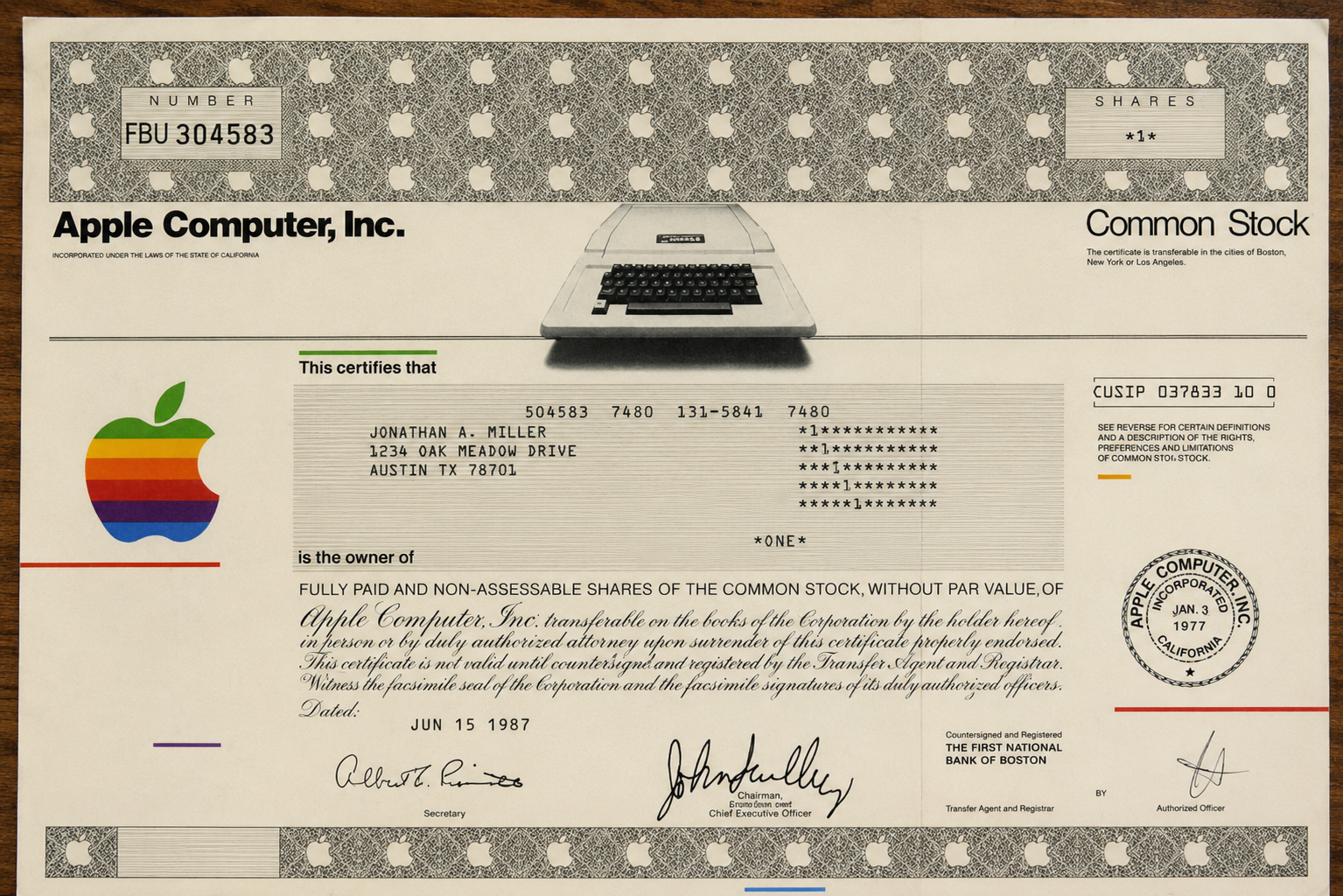
Not a real one. Image created with ChatGPT.
Another form of securities ownership is direct registrationwith the issuing company’s transfer agent. Under the Direct Registration System (DRS), shares (and very occasionally bonds) are recorded directly in your name on the books of the issuer or its transfer agent in electronic book-entry form. As the direct owner, you receive periodic statements, dividends, and other shareholder communications directly from the transfer agent or issuer rather than through a brokerage firm. When you wish to sell your shares, you can either 1) sell through the transfer agent by logging onto your account; the transfer agent then partners with a broker to execute the trade on the open market; or 2) transfer the shares into a brokerage account and then execute the trade. The second option typically has a transfer delay of one to five business days but generally has lower trading costs than selling directly through the transfer agent.
The added complexity of transacting shares owned through direct registration and paper certificates makes estate administration more challenging for the executor (or “personal representative” in some states, like Massachusetts and Florida). First, owning many securities in either form is more onerous administratively. Instead of having the securities neatly held in one or a few accounts at a brokerage firm, the executor has to locate each security. Then, when it comes time to sell or transfer the securities, the executor has to identify the correct transfer agent for each security, locate account numbers and/or certificates, complete transfer forms, obtain a medallion signature guarantee, and provide original documents including death certificates and court appointment papers. Obtaining a medallion signature guarantee alone can be a headache (a medallion signature guarantee is a special stamp from a participating financial institution that guarantees the authenticity of an executor’s or trustee’s signature for a securities transfer). The executor must first locate a bank that offers medallion signature guarantees (many do not) , and for those that do, many branches do not) and schedule an in-person meeting just to complete a transfer form. In many cases, that form then must be physically mailed to a transfer agent along with many other forms. This time-consuming process must be repeated for every security held as a paper certificate or through direct registration.
By contrast, when securities are held in an account at a brokerage firm, this part of settling the estate is fairly streamlined. The executor needs only to provide a death certificate and court appointment documents to the brokerage firm or the decedent’s advisor. The firm will then provide simple forms to retitle or liquidate the accounts. While that is being done, the brokerage firm can open an estate account and move all the securities into that account while awaiting the executor’s instructions. (This step is even simpler when the securities are held in trust. Unlike an executor, a trustee or successor trustee does not have to go through the trouble of getting appointed by a probate court and can manage the funds according to the terms of the trust without delay).
When securities are already aggregated in one or a few accounts, it is easy to locate positions from account statements, obtain date-of-death values, and sell or transfer shares under a single platform and fee schedule, all of which reduces time, cost, and risk that any securities are overlooked. This is not to say that if you own directly registered securities or paper certificates you need to dispose of these assets during your lifetime. Rather, you (and your financial advisor) should take stock of your various holdings and ensure that all paperwork and account information is properly and securely held.
As in many areas of personal finance, the more you share with your financial advisor, the better you’ll be equipping all the people who will be tasked with settling your estate—your executor, your attorneys, and, most of all, your family.